
Key Takeaways
An automatic gate looks simple enough from the driver’s seat – press a button and it opens – but there’s actually a fair bit of engineering behind that convenience. This guide breaks down the motors, sensors, and control systems that make automatic gates work, along with the safety standards Australian installers have to meet. By the end, you’ll know exactly what’s happening between the remote and the gate swinging open.
Most problems people run into with automatic gates come down to not really understanding how the system works in the first place, rather than an actual fault with the gate itself.
So How Do Automatic Gates Work? At the core, it’s a motor, a control board, and a handful of sensors all working together to move a heavy object safely, without anyone needing to get out of the car. Once you understand each piece, the whole thing stops feeling like some kind of mystery box. According to Accio, the aluminium gate market is expected to reach $2.5 billion by 2033, creating promising opportunities for new market entrants.
The Main Components of an Automatic Gate
Every automatic gate, no matter the brand or style, relies on the same basic building blocks, including custom aluminium gates designed to suit the property’s specific needs.Understanding how do automatic gates work starts with knowing what each of these components does and how they work together.
- The motor or operator, which provides the movement
- The control board, which manages the logic and timing
- The gate leaf itself, made from steel, aluminium, or timber
- Safety sensors and warning devices, which prevent accidents
The Motor or Operator
This is basically the muscle of the whole system. Electromechanical motors use a 24V DC electric motor paired with a gearbox or screw drive, making them a popular choice for most residential gates, including residential security gates that require reliable and controlled operation. Electro-hydraulic motors work a bit differently, using pressurised fluid instead, which delivers more torque and suits heavier commercial gates or ones that are opening and closing all day long.
When looking at how do automatic gates work, the motor is one of the most important components because it provides the mechanical force needed to open and close the gate.
The Control Board
Think of the control board as the brain of the operation. It interprets signals coming from a remote, keypad, or intercom, then tells the motor what to do. It also handles timing – like how long the gate stays open before it auto-closes – and manages safety overrides if a sensor picks up on a problem partway through the cycle.
To understand how do automatic gates work in practice, the control board is particularly important because it determines when the motor starts, stops, reverses, or remains idle.
The Gate Leaf Itself
Steel, aluminium, and timber-clad frames are all pretty common, and whichever material is used affects how much torque the motor actually needs. A heavier steel gate is going to ask a lot more of the motor than a lightweight aluminium one of the same size would.
Safety Sensors and Warning Devices
Photoelectric beams, safety edges, and flashing lights round things out. These are there for one reason: to stop the gate from turning into a hazard instead of a convenience.
These safety features are an important part of how do automatic gates work, because the system needs to monitor the gate’s surroundings while it is operating.
How Does Driveway Gate Automation Work?
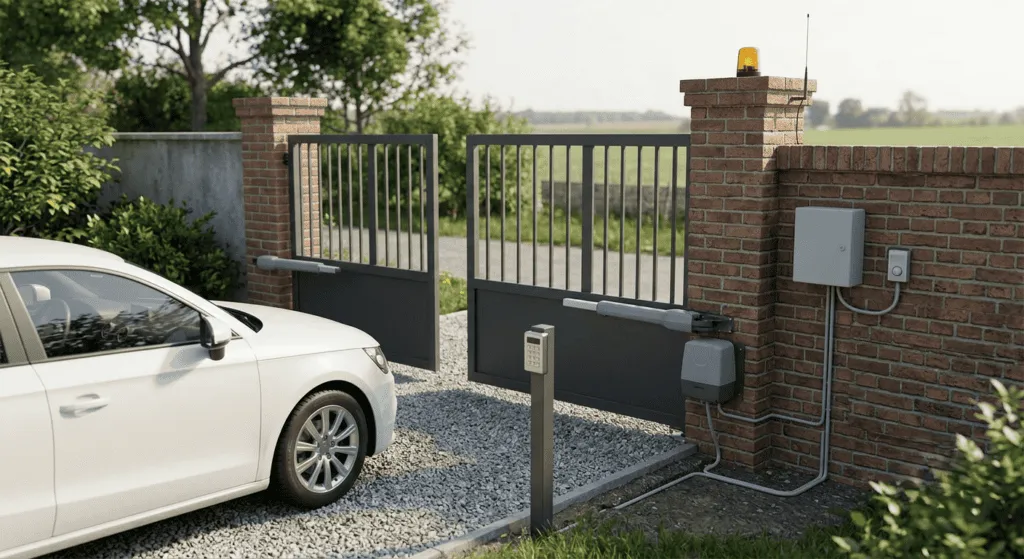
If you’re wondering, how do automatic gates work?, the process follows a pretty logical sequence. First, a signal is sent through a remote button, keypad code, or smartphone app. The control board receives the signal and checks whether it’s safe to proceed, ensuring none of the safety sensors are triggered. The motor then activates, moving the gate along its track or arc at a controlled speed. Once the cycle is complete, the gate either remains open until another command is received or automatically closes after a set delay.
A simple way to understand how do automatic gates work is to follow what happens from the moment you press the remote until the gate reaches its fully open or closed position.
Here’s the sequence laid out step by step:
- A signal is sent from a remote, keypad, or app
- The control board checks that no safety sensors are triggered
- The motor engages and moves the gate along its path
- The gate stays open or auto-closes after a set delay
Power Considerations Worth Knowing
Most residential automatic gate opener setups run on low-voltage 24V DC systems, which keeps things safe around kids and pets while still delivering enough power for smooth operation. Battery backup is becoming pretty standard too, since nobody wants to end up stuck outside their own driveway during a blackout.
Knowing how do automatic gates work also means understanding how the system handles power, particularly during outages or interruptions. Many systems use backup batteries, while manual release mechanisms provide another way to operate the gate if power is unavailable.
What Are Gate Safety Sensors and How Do They Work?
Gate safety sensors basically act as a set of digital eyes, keeping watch for anything – or anyone – in the gate’s path before and during movement.
Photoelectric sensors, often called photo eyes, project an infrared beam across the gate’s travel path. If something breaks that beam, the gate stops or reverses right away. Safety edges work a bit differently, using a pressure-sensitive strip along the gate’s leading edge that triggers a stop on physical contact rather than relying on a beam at all.
This is another key part of how do automatic gates work, because safety sensors allow the control system to respond when an obstacle is detected during operation.
Why This Matters More in Australia Specifically
Australian standards, particularly AS/NZS 60335.2.103, require force limitation and active safety devices on automatic gates to prevent crushing or shearing injuries. Compliant systems also need to provide at least a two-second warning, usually through flashing lights, before the gate even starts moving. This isn’t red tape just for the sake of it – a compliant sensor setup is genuinely what stands between a minor bump and a serious injury.
A few sensor types worth knowing about:
- Photoelectric beams, positioned to cover the gate’s swing or slide path
- Safety edges, mounted along the leading and sometimes trailing edge of the gate
- Loop detectors, buried in the driveway to detect vehicles waiting nearby
Sliding vs. Swing Automatic Gates: How Do They Differ?
The two most common gate styles actually work on genuinely different mechanical principles, and which one’s right really depends on the property itself.Understanding how do automatic gates work also requires looking at the different mechanisms used for sliding and swing gates.
Sliding Gate Mechanism
A sliding gate mechanism moves the gate horizontally along a track, either ground-mounted or cantilevered above ground. An electric sliding gate works well for sloped driveways and properties where a swinging arc just wouldn’t clear the space. Sliding gates also tend to handle wider openings a bit more gracefully than a single swing leaf would.
Swing Gate Motor Systems
A swing gate motor pivots the gate open on hinges, kind of like a household door but a lot bigger and heavier. Articulated arm motors and underground motors are both common setups, with underground versions usually preferred where a cleaner, hidden look matters more. Safety swing gates generally work best on flat driveways with enough clearance for the arc to swing through.
Swing gates also tend to feel a bit more traditional aesthetically, while sliding gates are usually the go-to for tighter urban blocks where space is at a premium.
A quick comparison:
- Sliding gates: Suit sloped or narrow driveways, handle wide openings well
- Swing gates: Suit flat driveways with clearance space, feel more traditional
Conclusion
Once you understand how do automatic gates work, the technology behind an automatic gate becomes much easier to understand.A motor provides the movement, a control board manages the operation, and safety sensors help prevent the system from becoming a hazard. Experienced aluminium fabricators can also ensure the gate is properly designed and built to suit the automation system. Whether a property is better suited to a sliding gate mechanism or a swing gate motor ultimately comes down to the available space and driveway layout.
FAQs
Are automatic gates safe to install at a residence?
Yes, as long as the system meets Australian standards like AS/NZS 60335.2.103, which requires force limitation and proper safety sensors. A compliant installation is built specifically to prevent crushing or trapping incidents.
What is the difference between electromechanical and hydraulic gate motors?
Electromechanical motors use a 24V DC motor with a gearbox, which suits lighter residential gates well. Hydraulic motors use pressurised fluid for higher torque, making them a better fit for heavier gates or high-frequency commercial use.
Can automatic gates operate during a power outage?
A lot of systems come with battery backup that keeps the gate working for a while during an outage. Most gates also have a manual release mechanism so they can be opened by hand if both power and battery fail.
How often should I service my automatic gate?
Generally speaking, an annual service is recommended, covering things like hinge lubrication, sensor testing, wiring checks, and making sure the gate’s travel limits are still set correctly.
Why Choose Schmidt Gates for Automatic Gate Solutions?
Schmidt Gates brings hands-on experience with both sliding and swing gate systems, making sure installations meet Australian safety standards from day one instead of needing costly retrofits down the track. Proper sensor placement and picking the right motor make the difference between a gate that lasts for years and one that needs constant repairs.