
📌 Key Takeaways
Commercial gates help businesses create a safer, more controlled, and secure environment for customers, and visitors. Different styles, including sliding, swing, cantilever, and barrier gates, are available to suit various commercial applications. Modern automation and access control features make managing entry and exit easier and more efficient. Careful planning and professional installation can ensure the gate meets both security and operational needs.
A commercial gate does far more than mark the entrance to a property. It helps control access, protects valuable equipment, improves workplace safety, and creates a more professional first impression for customers and visitors. Whether you manage a warehouse, office complex, retail centre, or industrial facility, choosing the right gate can make a real difference to both security and day-to-day operations.
With so many options available, from sliding and swing gates to automated access systems, it isn’t always obvious which solution best suits your business. The right choice depends on factors like traffic volume, available space, security requirements, and long-term maintenance.
This guide covers everything businesses need to know about commercial gates, including the different types, key benefits, material options, smart security features, and practical tips for choosing a system that fits your property and budget.
How Commercial Gates Differ from Residential Gates
People assume a gate is a gate. Give it a hinge, give it a motor, and job done. Not quite.
Residential gates are built for a household. Light traffic, a modest budget, maybe two cars a day rolling through. Commercial entrance gates are a different animal altogether, and they’re built that way for good reason.
Traffic and durability
A logistics yard sees trucks, forklifts, staff cars, and the odd lost courier van all day, every day. That kind of use wears out a flimsy gate within months. Commercial gates need a heavier frame, stronger hinges, and a motor rated for constant cycling rather than the occasional school run.
Speed matters more
Nobody wants a queue of delivery trucks idling at the boundary because the gate takes forty seconds to open. Commercial systems are usually built for faster cycle times, partly for convenience and partly because idling trucks aren’t great for anyone’s blood pressure.
Security expectations are higher
While different types of security gate systems serve different purposes, a home gate is generally designed to discourage wandering or casual entry. A business gate, especially as part of a security gate for a business driveway setup, often needs to stop someone who is intentionally trying to gain access. This typically requires thicker materials, anti-climb features, and integration with an access control system. Commercial properties also face stricter council regulations and insurance requirements than most residential homes.
Benefits of Commercial Gates
The upfront cost makes some owners wince; I won’t pretend otherwise. But once it’s in the ground, the payoff tends to show up in ways people don’t expect.
Commercial gates aren’t just becoming more common because individual businesses want better security. The wider market is also seeing steady demand as workplaces put more emphasis on controlled access and safety. According to Business Research Insights, the global industrial safety gates market is projected to grow from USD 0.53 billion in 2026 to USD 0.64 billion by 2035, representing a CAGR of 2.3% between 2026 and 2035.
Deterrence does most of the heavy lifting. Most break-ins are opportunistic, not planned out with blueprints. A solid, visible gate removes the easy option, and a lot of would-be trouble simply moves along to the next property.
There’s also the access control side of things. Instead of your receptionist doubling as an unofficial security guard, wondering who just wandered into the car park, a gate with an intercom or keypad handles that job automatically. One less thing on someone’s plate.
Insurers notice more than people realize too. A few brokers will trim your premium slightly if your perimeter security is solid, gates included. It’s rarely a massive saving by itself, but stack it with alarms and cameras, and it adds up over a year.
Then there’s the impression it leaves. A tired chain-link fence with a rusty gate says one thing about a business. A tidy, well-fitted gate says another, and clients pick up on that before anyone’s said a word.
And don’t overlook the practical side: keeping forklifts, delivery vehicles, and foot traffic separated where it counts. That’s less about theft and more about not writing an incident report on a Monday.
Types of Commercial Gates
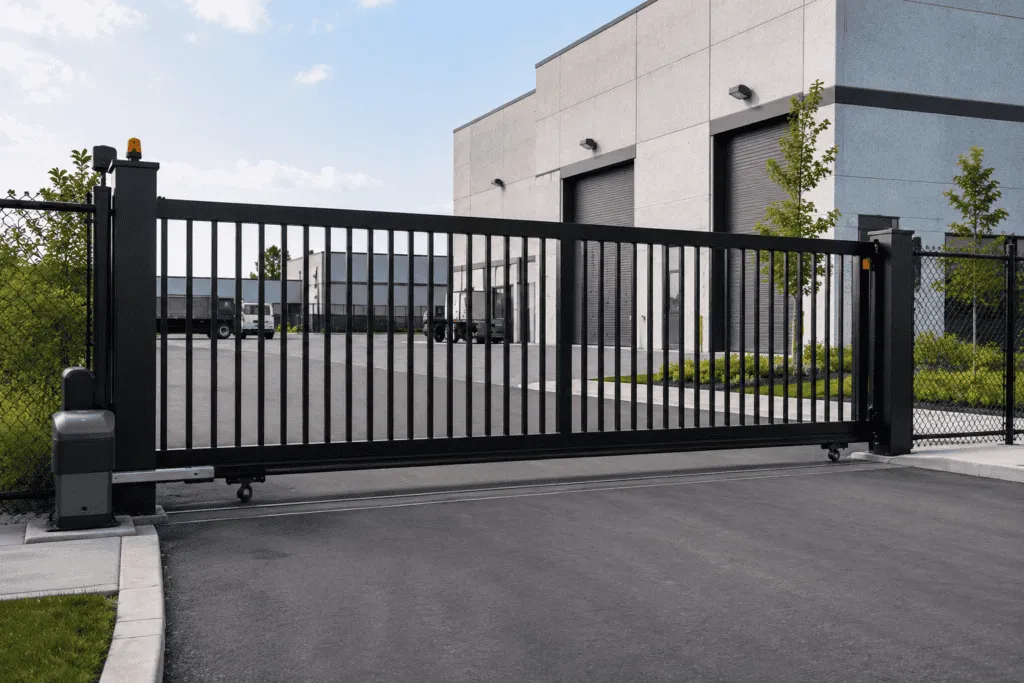
There’s no single right answer here. What suits a retail strip won’t suit a freight depot, and that’s genuinely fine.
Sliding gates
These run along a track and slide sideways rather than swinging out. Good for driveways with limited depth but decent width along the boundary. They stay clear of footpaths and traffic, which matters near a busy road.
Swing gates
The classic hinge-and-swing setup. Cheaper to install in a lot of cases, but they need room to open safely, so tight sites can struggle with this option.
Cantilever gates
Self-supporting, no ground track required. That matters on uneven surfaces or where debris and ice could jam a standard track system. Distribution centres tend to favour these.
Bi-fold gates
Useful for wide openings where there isn’t space for a long straight slide. Less common, but worth asking your installer about if your entrance is unusually wide.
Barrier and boom gates
Common at staff car parks, where the goal is controlled vehicle access rather than a fully enclosed perimeter. Quick to open, quick to close, keeps queues from forming.
Material choice matters as much as the style. Aluminium driveway gates are light, resist rust, and barely need upkeep, which explains why so many Australian businesses default to them. Aluminium security gates offer a solid middle ground between strength and cost. Steel sits above both in raw toughness, usually reserved for sites where the risk genuinely justifies it.
Smart Security Solutions for Commercial Gates
Gates has quietly gotten smarter over the last few years, and honestly, it’s changed the conversation around business entrances. Automatic gates aren’t a luxury add-on anymore; they’re close to the default expectation.
Remote and app-based control
An electric sliding gate paired with a phone app means nobody’s hopping out of a ute in the rain to wrestle with a manual chain. Property managers running several sites can check or operate automatic gates for driveways without driving across town, which saves a surprising amount of time over a year.
Number plate recognition
Some systems now link gate access to plate recognition. Regular delivery vehicles get waved through automatically, while unfamiliar plates get flagged for a manual check. It’s a small feature that quietly does a lot of work.
Integration with building systems
Others tie gate activity into building management software, logging every entry and exit with a timestamp. That log becomes genuinely useful the one time you actually need to know who was on site.
Here’s an observation from watching this play out across a few sites: smart features are only as good as the maintenance behind them. A brilliant app-controlled gate nobody’s updated in two years isn’t smart security anymore, it’s just a gap with better marketing. Technology helps. It doesn’t replace someone actually checking the hinges once in a while.
Choosing the Right Fit
Think about actual traffic patterns before your worst-case security fears take over. A small office with light foot traffic doesn’t need what a freight depot running trucks all day needs. Budget matters, sure, but the cheapest option upfront has a habit of costing more in repairs three years down the track.
Check local council rules too, particularly around setbacks and automatic gate safety standards, before locking in a design. A decent supplier walks you through this. If they don’t, that’s worth noticing.
Secure Your Property with Commercial Gates
A gate is one of the few security investments that keeps working around the clock without a password reset or a firmware update. It won’t stop everything; nothing does, but it closes an obvious gap that a lot of businesses leave open simply because nobody got around to it. Warehouse, retail centre, or a modest office park, the right gate earns its keep quietly, year after year, without asking for much in return.
FAQs
How much do commercial gates typically cost?
It depends heavily on size, material, and automation. A basic manual swing gate might start around a few thousand dollars. A fully automated sliding or cantilever setup with smart access control can climb well into five figures. Get a few quotes before deciding anything.
How often should commercial gates be inspected and maintained?
Most manufacturers suggest a professional check every six months, with a basic visual look-over monthly in between. Motors, hinges, and sensors wear faster on busy commercial sites than they do on a quiet suburban driveway, so don’t let that schedule slip.
Which gate material offers the best durability for high-security commercial applications?
Steel generally wins on raw strength against forced entry. Aluminium security gates hold up well too and resist corrosion better, which matters a lot near the coast, though they give up a little toughness in return.
Are sliding or swing gates better for commercial properties?
Depends on the site. Sliding gates suit limited depth or busy pedestrian areas nearby. Swing gates work fine where there’s room to spare and a simpler mechanism is preferred. Neither wins outright; it’s about matching the gate to the property.
Why choose Schmidt Gates for your commercial security needs?
Schmidt Gates provides durable, high-quality commercial security gate systems designed to protect businesses while ensuring reliable access control. With expert installation, customized solutions, and a focus on long-term performance, the company delivers gates that meet the security needs of a wide range of commercial properties.