
Key Takeaways
Sliding gates for driveways give security while not using extra room. They are useful for sloped or short driveways where a swing gate would not fit. The price depends on material, track style. If sliding gates are automated. This guide explains the types, the costs and the steps of installation.
A driveway gate has to fit the space it occupies. The shape of the driveway the slope of the ground and how room there is all influence which gate will work best.Sliding gates for driveways are a practical choice because they fit driveways wherea swinggate cannot open properly. This guide explains the types of sliding gates the benefits, the costs and the installation steps in plain words. According to Accio, the aluminium gate market is projected to reach $2.5 billion by 2033, highlighting significant growth opportunities for new businesses entering the industry.
What Are Sliding Gates for Driveways?
A sliding gate is a gate that moves sideways on a track of swinging on hinges. It can move along a track set into the ground or hang from a cantilever system above the ground.This difference in how sliding gates for driveways move changes where they can be used and how well they perform.
Driveway sliding gates work well where space is tight. For homeowners considering sliding gates Gold Coast,sliding gates for driveways areparticularly useful when the driveway slopes upward, is close to the footpath, or does not have enough space for a gate to swing open. A swing gate requires space to move through. A sliding gate only needs a path along the fence line.
There are two types of sliding gates.
Track‑Mounted Sliding Gates
A track‑mounted sliding gate moves along a track set into the ground. Rollers under the gate guide its movement.
- Usually cheaper than cantilever gates
- Best suited to level driveways
- The track needs cleaning because dirt and leaves can build up and slow sliding gates for driveways
Cantilever Sliding Gates
A cantilever sliding gate does not touch the ground. An internal frame and rollers on the posts carry the weight of sliding gates.
- No ground track, so nothing to clean or clog
- No raised track,. There is no trip hazard
- Works well on sloped or uneven ground
- Costs more than a track‑mounted gate because the engineering is more complex
Choosing a Material
The material of sliding gates for drivewayschanges how they look and how upkeep they need.
- Aluminium sliding gates are a choice for Australian homes. Aluminium does not rust it is lighter than steel. It can be powder‑coated in many colours.
- Steel and wrought iron gates have a traditional look. They need maintenance than aluminium especially in coastal areas where salt air causes faster corrosion.
Benefits of Sliding Gates for Driveways
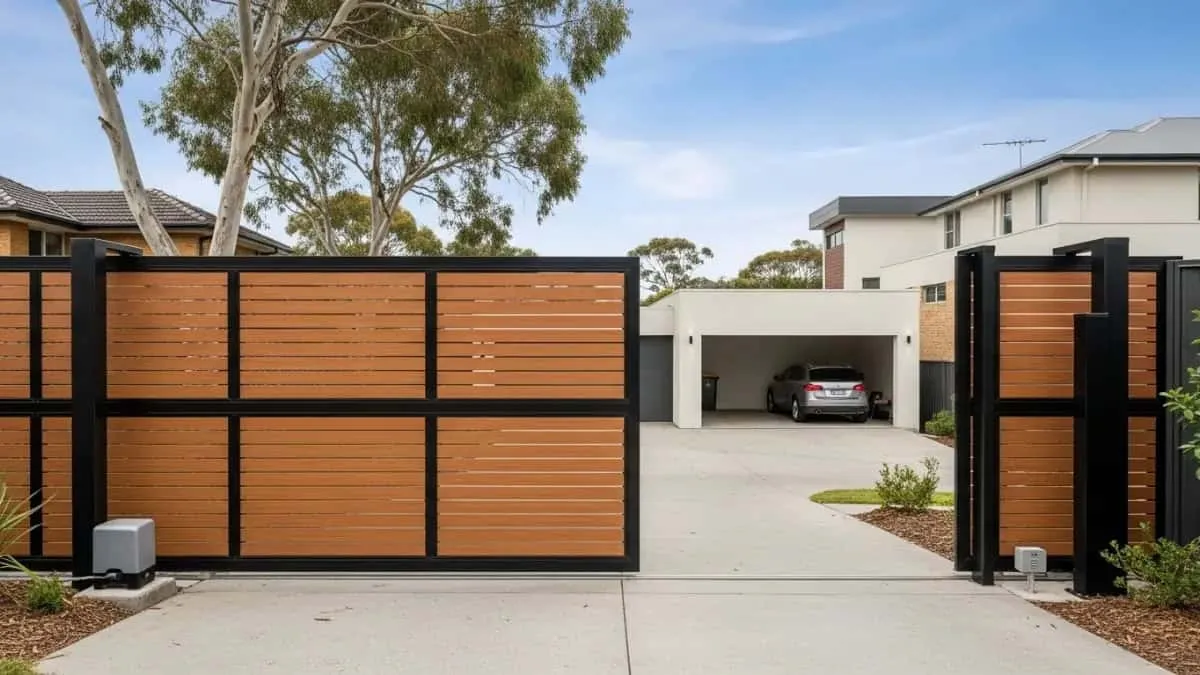
Sliding gates for driveways give practical advantages.
Space efficiency: A swing gate needs space to move through which is hard on a sloped block or a driveway close to the street. A sliding gate does not need this space.
Stronger security: Sliding gates are harder to force open because there is no hinge point to attack. The gate sits flush against the fence line of bowing out under pressure. Adding an access control system makes security even stronger.
Better wind resistance: A swing gate has a surface that catches wind, which puts strain on its hinges and posts over time. A sliding gate runs parallel to the fence line so it has surface exposed to wind. This helps in exposed places.
Easy to automate: Most sliding gates can be automated with a motor, remote control, intercom or number plate recognition camera. Automation makes sliding gates easier to use every day.
Better appearance: A well-designed sliding gate made from aluminium with a slatted design can enhance the look of a property, making aluminium gates a stylish and practical choice for modern driveways.
First security is usually the reason homeowners picksliding gates for driveways.Second the space‑saving benefit becomes clear once the size of the driveway is measured against the space a swing gate would need.
Sliding Gate Installation: What to Expect
Installing a electric sliding gates has stages. It needs experience in fencing, concreting and electrical work. It is not a task for someone without the right skills.
The Site Assessment
An installer first checks the site conditions:
- Is the ground flat or sloped?
- What type of soil is present?
- Is there existing concrete. Will new footings be needed?
This assessment shows whether a track‑mounted or cantilever gate is more suitable for the propertyand which type of sliding gates for driveways will work best.
Measuring and Design
The next step is measuring the opening. Confirming the width, height and material of sliding gates. At this stage the choice is usually made between a gate for privacy or a slatted design that lets light and air through. Custom sliding gates are used for driveways with a width or a specific design requirement.
Footings and Framework
Concrete footings need time to set before they can support any weight. Depending on the ground conditions this stage can add one or two days to the installation timeline.
Fitting the Gate and Track
Once the footings are set the gate frame is. The track or cantilever system is fitted and levelled.If sliding gates for driveways are not aligned correctly, they will not move smoothly. The rollers will wear out faster.
Automation and Testing
If automation is included the motor is. Calibrated.The installer tests sliding gates for driveways several times,checking the sensors, safety edges and remote control before finishing the installation.
A standard installation usually takes one to three days. Automation, custom design work or difficult ground conditions can extend this to a week. Sliding driveway gates cost depends on size, material and level of automation. As a guide a fully installed sliding gate typically costs between $3,000 and $10,000. Cantilever systems and custom designs usually sit at the end of this range.
Final Thoughts on Sliding Gates for Driveways
The right gate depends on the shape of the driveway, the required level of security, and the available budget. Schmidt Gates can help homeowners choose a suitable sliding gate for driveways where swing gates may not fit, with proper site assessment, quality materials, and thorough automation testing helping ensure reliable performance over time.
FAQs
Are sliding gates good for driveways?
Yes, in cases. Sliding gates work well for narrow or short driveways where a swing gate would not have enough room to open. Sliding gates also handle wind better than swing gates.
How much does a sliding driveway gate cost?
Most fully installed sliding gates fall somewhere between $3,000 and $10,000, depending on size, material, and whether automation is included. Custom designs and cantilever systems sit toward the higher end.
How long does sliding gate installation take?
A standard installation usually takes one to three days. Jobs involving custom fabrication, difficult ground, or full automation can stretch closer to a week.
Can sliding gates for driveways be automated?
Almost always. Motors, remotes, keypads, intercoms, and even number plate recognition can all be added, whether fitted during installation or retrofitted later.
Why choose Schmidt Gates for sliding gates for driveways?
Schmidt Gates brings hands-on experience with both track-mounted and cantilever systems, works across a range of materials including aluminium, and handles everything from site assessment through to automation and testing, so the finished gate is set up properly from day one rather than needing adjustments down the track.