
 Key Takeaways
 Key Takeaways
Electric swing gates provide convenience, security, and improved kerb appeal by opening and closing automatically with a motorised system. They are available in single- and double-leaf configurations, making them suitable for different driveway sizes and layouts. Proper installation requires careful planning, strong foundations, suitable motor sizing, and compliant electrical work. Regular maintenance, including sensor checks, lubrication, and professional servicing, helps extend the gate’s lifespan and ensure safe, reliable operation.
An electric swing gate is cool. It. Closes by itself like a regular gate, but it has a motor that does all the work. You do not have to push it with your hands. This guide will tell you why electric swing gates are an idea, how to put one in, and what you have to do to keep it working well once it is installed. Electric swing gates are worth thinking about because they make life easier. The guide will also explain how to install an electric swing gate and what to expect for upkeep. According to Market Report Analytics, Swing Gate Market Revenue was valued at USD 1.2 billion in 2024 and is estimated to reach USD 1.9 billion by 2033, growing at a CAGR of 5.5% from 2026 to 2033.
A gate left open by mistake defeats the whole point of having one. Happens constantly with manual gates: someone’s arms full, rain coming down, gate left ajar for the next ten minutes. An electric swing gate removes that failure point entirely. Motorised, automatic, closes on its own every time.
Understanding Electric Swing Gates
An electric swing gate operates on the same basic principle as a traditional hinged gate. The difference is the motor. A motor drives the arm, opening and closing the gate through a swinging motion rather than sliding along a track.
There are two kinds of gate configurations. A single swing gate has one part that is attached to one side. It swings open all the way across the driveway. A double swing gate has two parts that meet in the middle, with each part covering half of the opening.
If you have a wide driveway, double gates are usually a better choice because they require less space to swing open and can distribute the weight more evenly. If you’re unsure which setup is right for your property, electric gate installers near me can assess your driveway and recommend a suitable gate and motor system.
How They Actually Work
A control unit, usually wall-mounted near the gate or inside the property, sends a signal to the motor. Remote controls, keypads, or smartphone apps trigger that signal, depending on the setup. The motor then drives an arm connected to the gate, pushing or pulling it open along its arc. Safety sensors, standard on quality installations, detect obstructions and stop the gate before it makes contact with a car, a person, or the family dog wandering through at the wrong moment.
Benefits of Electric Swing Gates
Automatic swing gates offer more than just convenience, though convenience alone sells plenty of them.
Property security improves noticeably with a gate that closes reliably every time, rather than depending on someone remembering to shut it. Curb appeal gets a boost too; a well-chosen gate design adds real presence to a driveway entrance, something a lot of homeowners underestimate until they see it done well.
- Consistent, reliable closure without relying on manual effort
- Remote access, useful for deliveries or letting visitors in without leaving the house
- Reduced unauthorised access compared to a manual or unlocked gate
- Genuine kerb appeal improvement for the right property style
Electric gate installation also opens the door to broader home automation integration. Swing gates for driveways can be synced with security cameras, smart locks, access controls, or a general smart home system, allowing homeowners to manage and monitor gate access more conveniently. For families managing kids or pets, an electric gate adds a real layer of containment that a manual gate, often left open, simply doesn’t provide consistently.
Electric Swing Gates for Driveways Specifically
Electric swing gates for driveways suit properties with adequate clearance space, since the gate needs room to swing open without hitting a car parked too close or a garden bed positioned awkwardly. Sloped driveways add complexity here too, worth flagging early rather than discovering it mid-installation.
Installation of Electric Swing Gates
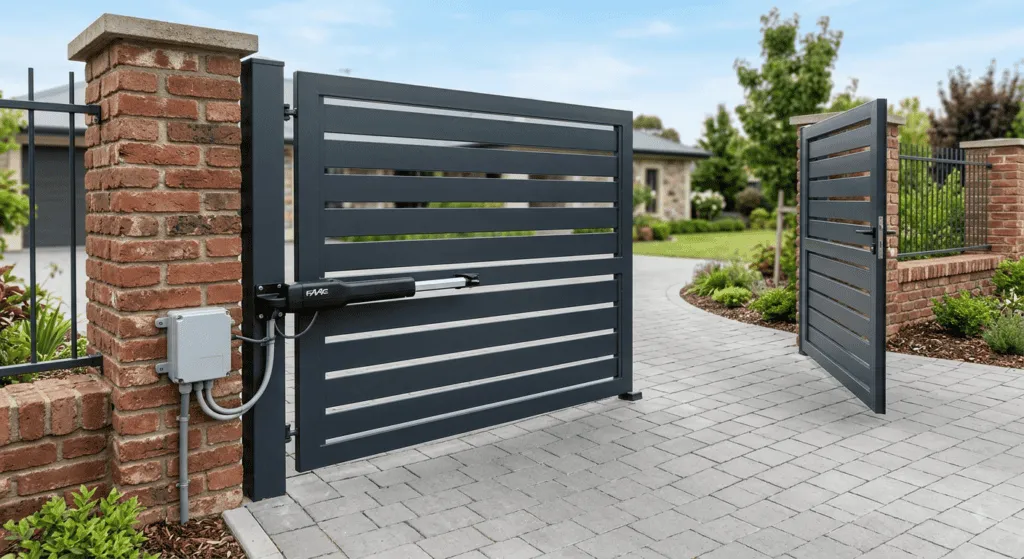
Electric gate installation involves more moving parts than people expect, walking in, pun somewhat intended.
Site assessment comes first. A qualified installer checks driveway width, slope, power access, and swing clearance before recommending a single- or double-leaf configuration. Underground power access typically needs to be run from the house or a nearby power point, and in Australia, this work usually requires a licensed electrician for compliance with local wiring regulations.
Foundation work follows. Gate posts need a solid footing, generally concrete, sized appropriately for the gate’s weight and the motor’s pulling force. Skimping here causes problems down the track; a gate that sags or drifts out of alignment within a year or two isn’t uncommon when the footing wasn’t done the first time properly.
Typical Installation Timeline
Most residential electric swing gate installations take one to three days, depending on site complexity and whether power needs to be run a significant distance. Straightforward jobs, existing power nearby, flat driveway, can sometimes wrap in a single day. Sloped sites or longer power runs push that out considerably.
Choosing Between Single and Double Leaf
Single leaf gates suit narrower driveways and cost less overall, fewer components, simpler motor requirements. Double leaf gates handle wider openings better and often look more balanced aesthetically on a grand entrance, though they cost more due to the second motor and additional hardware involved.
Maintenance of Electric Swing Gates
Electric gate maintenance matters more than most homeowners realise until something stops working at the worst possible moment.
Regular visual checks can help catch small issues before they become expensive repairs. For safety swing gates, inspect the hinges and gate frame for rust, check for loose bolts, and look for fraying cables if the system uses a cable-driven mechanism rather than a direct arm. Lubricating the hinges and other moving parts every few months helps ensure smooth operation, reduces motor strain, and supports safe, reliable gate performance.
- Check safety sensor alignment periodically, since a knocked sensor can cause the gate to behave erratically or stop responding
- Test the manual release mechanism occasionally, since most gates include one for power outages
- Have the motor professionally serviced annually, particularly for gates used frequently
- Keep the swing area clear of overgrown plants or debris that could interfere with sensors or the arc itself
When to Call a Professional
DIY troubleshooting works fine for obvious issues, a dead remote battery, or an obstructed sensor. Anything involving the motor itself, wiring, or control board issues really needs a professional, both for safety and to avoid voiding whatever warranty came with the system.
Conclusion
An electric swing gate really is worth the money for the home, better safety, real ease and a big improvement in how the house looks from the street. Doing the installation properly from the start good base support, the size motor and expert electrical work avoids problems down the road. Keeping up with maintenance, not much, to it just paying attention on a regular basis keeps the whole system working for many years instead of turning into a costly fix within just a few seasons.
FAQs
What is the average cost of installing an electric swing gate?
Costs vary considerably based on gate size, materials, and site complexity, though most Australian homeowners can expect somewhere in the range of a few thousand dollars for a standard residential installation.
Can electric swing gates be installed on uneven or sloped driveways?
Yes, though sloped sites often require additional engineering, adjusted footings, or a stronger motor to manage the gate’s swing safely and consistently.
How long do electric swing gates typically last?
A good electric swing gate that is installed correctly and taken care of can work for 15 to 20 years. The motor parts might need to be fixed or replaced earlier. This depends on how the gate is used.
Are there any safety features included in electric swing gates?
Quality systems include obstruction sensors, auto-reverse functions, and manual release mechanisms for power outages, all designed to prevent injury or property damage.
Can electric swing gates be integrated with home automation systems?
Yes, many modern systems support integration with smartphone apps, smart locks, and broader home automation setups, allowing remote monitoring and control from anywhere.
Why choose Schmidt Gates for an electric swing gate?
Schmidt Gates brings hands-on experience with proper footing work, motor sizing, and compliant electrical installation- the details that actually determine whether a gate holds up long-term or becomes a recurring headache.